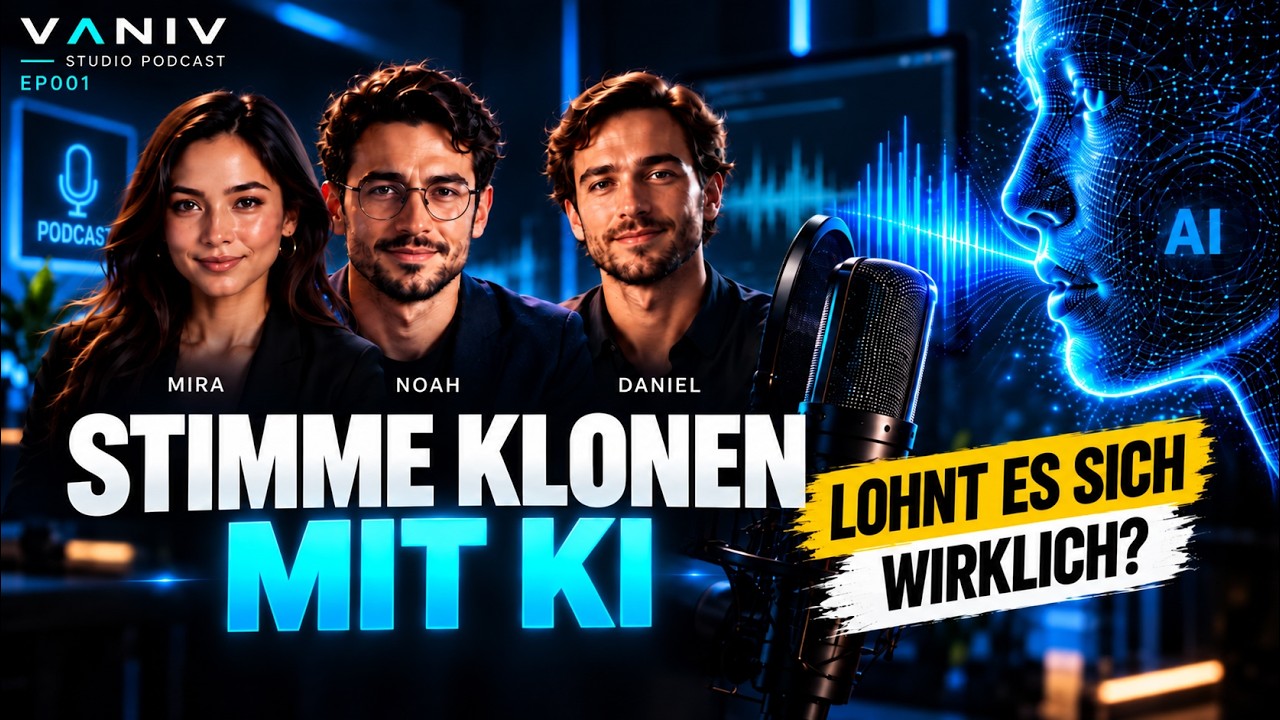
Mira
Mira leads the show, keeps the discussion understandable and brings technical topics back to the question that ultimately matters: what does this mean for real users and creators?
“Okay – but what does this actually do for me?”
Mira, Noah and Daniel break down what actually matters for creators and local AI: voice cloning, video dubbing, hardware, privacy, cost and the question of what really works in practice.
The hosts are not interchangeable voices. Each one owns a different perspective so every episode has tension, questions and genuinely different priorities.
Mira leads the show, keeps the discussion understandable and brings technical topics back to the question that ultimately matters: what does this mean for real users and creators?
“Okay – but what does this actually do for me?”
Noah goes under the hood. Models, ONNX, GPU and CPU, VRAM, local processing, performance and technical limits are his territory. Marketing claims get challenged.
“What is really happening technically – and where is the catch?”
Daniel looks at cost, product value and scalability. He asks whether a workflow saves time, whether local AI makes economic sense and when interesting technology becomes a useful product.
“Is it just cool – or is it actually worth it?”
The first episode starts where VANIV comes from: voice cloning, local processing and the question of how an AI model becomes a useful creator workflow.
Mira, Noah and Daniel discuss when voice cloning is genuinely useful, why a clean reference recording matters, why local processing is especially interesting for voice data and where technology alone still does not create a good workflow.
VANIV is bigger than voice cloning. The podcast connects the technical side of local AI with creator production, hardware and business decisions.
Voice quality, reference recordings, voice design, pronunciation, multilingual use and responsible workflows.
Local video translation, multi-speaker dubbing, timing, lip sync and production-ready workflows.
Running models locally, using hardware efficiently and knowing when CPU, GPU or ONNX actually helps.
Which hardware makes sense for a specific local workflow.
Cloud subscriptions versus local hardware, scaling, productivity and the economics of your own AI workflows.
Consent for voices, data protection, transparency and questions generative AI should not ignore.
The podcast does not glorify local AI or dismiss cloud tools. Control, quality, cost and the concrete use case are what matter.
Technical statements are made as concrete and testable as possible.
A model becomes interesting when it creates a working workflow.
Local processing is a strong approach – not a dogma.
The hosts are transparently presented as AI characters.
New episodes land on YouTube first, together with videos about local AI, voice cloning, dubbing and hardware.
VANIV Studio on YouTube