
Local ElevenLabs alternative: AI voices, voice cloning and dubbing with more control
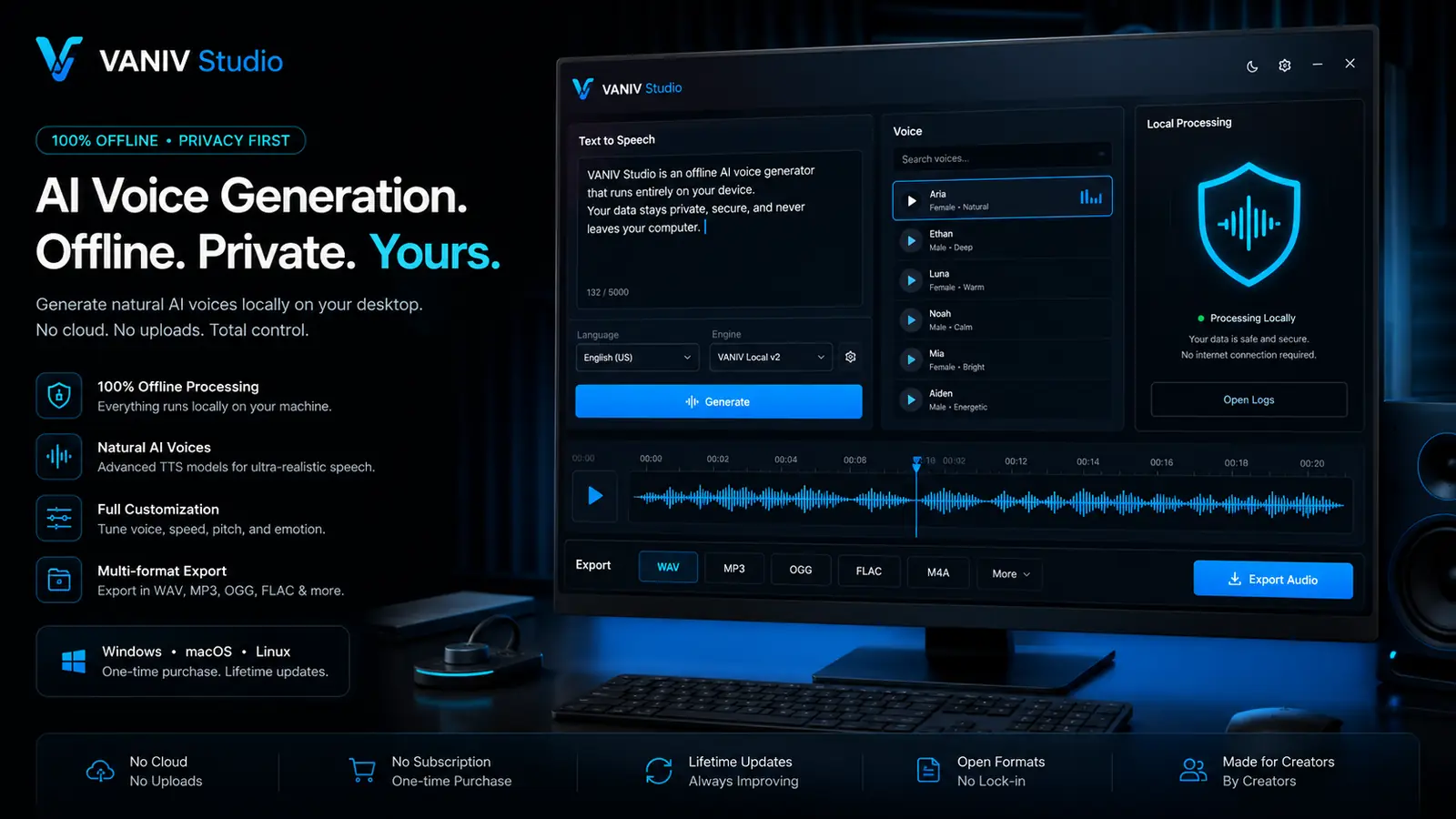
Looking for a local ElevenLabs alternative because you do not want AI voices, voice cloning and voiceover production to live only inside a cloud demo workflow? VANIV Studio is built for creators who want to connect voice, video dubbing, subtitles and export in a more controllable local-first workflow.

What kind of ElevenLabs alternative are you actually looking for?
Not everyone wants the same alternative. Some users want lower costs. Others want local files, more privacy, their own voices, dubbing or a full creator workflow.
AI voice without pure cloud workflow
If you do not want every project to live fully inside a browser tool, a local-first voice generator becomes more interesting.
Control local voice cloning
If your own or authorized voices should be reused, rights, files, speaker profiles and repeatability matter.
More than audio: video dubbing
If voices should become new language versions of videos, you need translation, timing, subtitles and export.
Understand cloud vs local AI
Cloud is convenient. Local becomes stronger when control, privacy and recurring workflows matter more.
Why this page is not another “VANIV vs ElevenLabs” clone
People searching for VANIV vs ElevenLabs usually want a direct comparison between two solutions. People searching for “local ElevenLabs alternative” often have a different goal: they are not only comparing tools, they are looking for a direction away from pure cloud dependency.
That is why this page is not here to attack ElevenLabs. ElevenLabs is known, convenient and strong when fast AI voices in the browser are the goal. For many users, that is the right answer. The point is that not every creator wants to control long-term voice production through a cloud account, credits, uploads and platform logic only.
VANIV starts from a different angle. It focuses more on local-first production: your own or authorized voices, recurring projects, video dubbing, subtitles, export and more control over files. It is less about “quickly try one voice” and more about “build a production workflow”.
That is the difference between a comparison page and an alternative page. This page helps you decide whether you actually need a local alternative — and which requirements your workflow should meet if you do.
When a local ElevenLabs alternative makes more sense
You produce regularly
If you create voiceovers, Shorts, tutorials, product videos or course content every week, repeatability matters. You do not want to rebuild, retest and reorganize every project from scratch.
You use your own voices
If you want to use your own voice or clearly authorized voices, rights, approvals, speaker profiles and clean project structure matter more than one quick demo sentence.
You work with video
For video dubbing, an isolated audio file is not enough. You need translation, timing, subtitles, export and control over how speech fits the video.
You want less platform pressure
If credits, limits, uploads or pure cloud dependency slow you down, local-first is not automatically easier, but it can be more controllable long term.
When ElevenLabs or another cloud tool probably fits better
A local solution is not the best choice for everyone. If you only need an occasional short voiceover, do not want local hardware and mainly want browser results quickly, a cloud tool is often more convenient. The broader VANIV comparison hub helps separate tool-specific differences from the general cloud-versus-local decision.
Cloud tools remove many technical questions. You think less about GPU, storage, local models, installation or file structure. For one-off projects, quick tests or simple voiceover production, that is a real advantage.
VANIV becomes more interesting when voice becomes a recurring part of your production. Once you have multiple videos, several languages, recurring speakers, sensitive files or many export variants, the fastest start is no longer the only thing that matters. Control starts to matter more.
Cloud for quick tests
If you only want to test whether a voice works, cloud is often the easier path.
Local for series
If voice is needed regularly, a local workflow becomes more valuable.
Cloud for low setup
If you do not want hardware questions, browser tools are often more comfortable.
Local for control
If you want to organize files, voices and projects long term, local-first is worth testing.
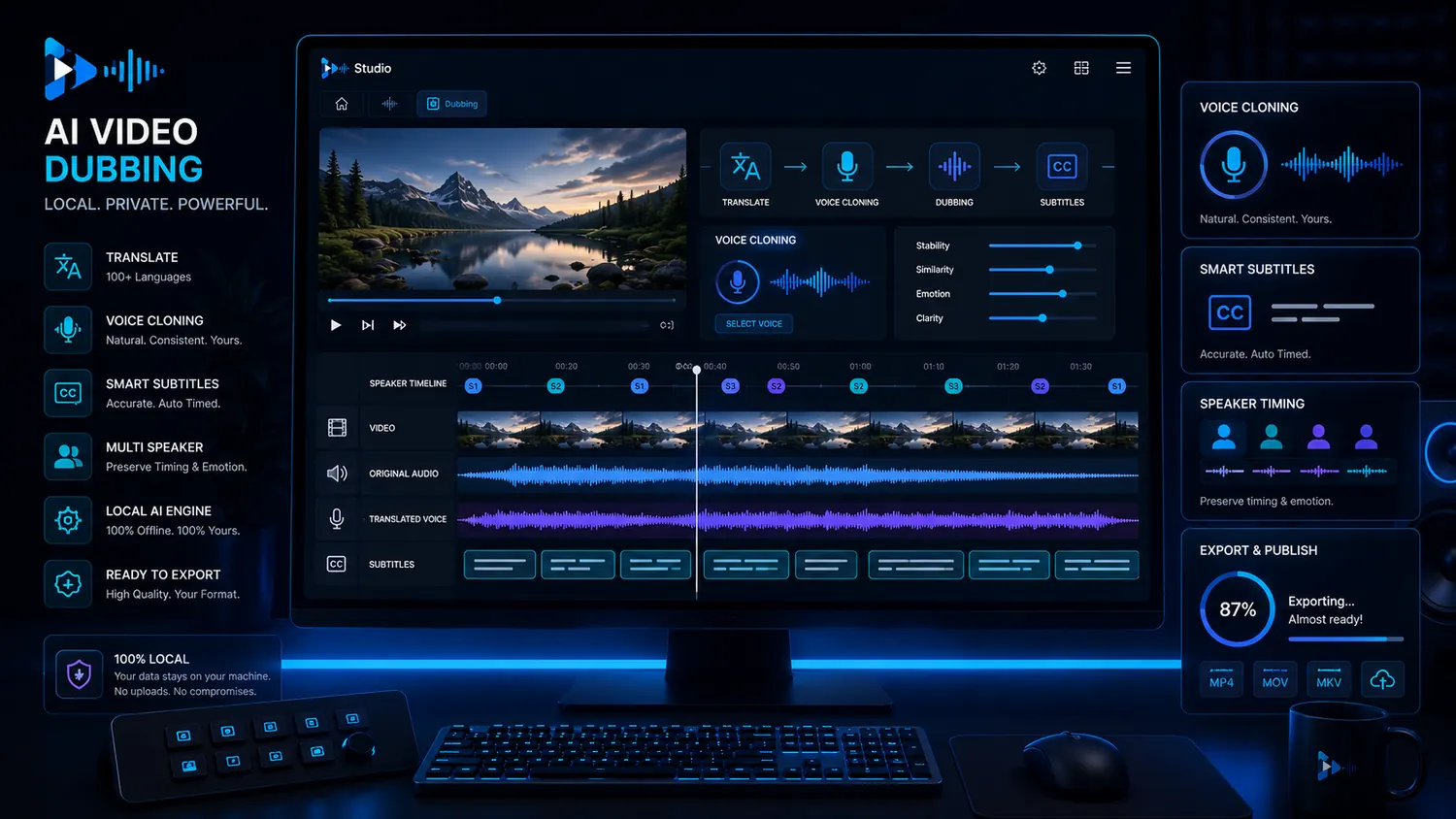
How a local voice workflow with VANIV is designed
A local ElevenLabs alternative should not only turn text into audio. It should make creator production more repeatable.
Prepare the voice
Use your own or clearly authorized voices. Rights and consent belong before the workflow, not only before publishing.
Import text or video
Depending on the project, you create a voiceover, a language version or a video dubbing workflow.
Generate and review voice
Sound matters, but so do consistency, corrections, speaker role and intelligibility.
Repeat export
The value grows when several versions, languages or clips can be created predictably.
Less subscription and credit pressure does not automatically mean free
Many people look for an ElevenLabs alternative because subscription models, credit systems or usage limits become annoying. That is understandable. Still, it would be wrong to claim that local automatically means free or always cheaper.
Local AI needs hardware, storage, setup and maintenance. A strong GPU, enough RAM and a fast SSD can make the workflow much more comfortable. In return, you gain more control over your production environment and can build recurring projects more structurally.
The better question is not only: “What does the tool cost?” The better question is: “How often do I produce, how many versions do I need, how sensitive are my files and how much control do I want?” For recurring production, local-first can become strategically stronger.
- Local is not automatically cheaper, but more controllable.
- Cloud is convenient, but can feel limiting at higher production volume.
- Hardware is part of the local cost calculation.
- Repeatable workflows matter more than demo results.
Voice cloning needs consent — whether cloud or local
A local ElevenLabs alternative does not automatically solve legal questions. You should only use your own, self-recorded or clearly authorized voices. That applies to cloud tools just as much as local tools.
Anyone working professionally with voice cloning should document approvals, clarify usage and avoid using voices to mislead people. As AI voices become more realistic, trust becomes more important.
VANIV’s local-first approach can help organize files and speaker profiles more consciously. But the responsibility remains with the user. Good creator workflows are not only technically strong, but also clean in how they handle rights and consent.
Your own voice
The simplest workflow is your own voice, because the rights question is clear.
Client voice
You need clear approval, purpose, scope and ideally documented consent.
Third-party voice
Without permission, you should not clone or publish other people’s voices.
Transparency
For sensitive use cases, it may be wise to label AI-generated voice transparently.
How to move from a cloud voice workflow to local-first sensibly
You do not have to replace everything overnight. The best path is a controlled test with a real project.
Choose a real voice project
Do not use a demo script. Use a real YouTube intro, tutorial, product demo, course lesson or voiceover that you would actually publish.
Document the cloud result
Do not only save the audio. Note effort, corrections, variants, export time, cost logic and how easily you can continue working on the project later.
Test the local workflow
In VANIV, check how voice, text, dubbing, subtitles and export feel. The first sound is not enough; repeatability matters.
Decide by workflow
If cloud is faster and completely enough, stay there. If you need more control, versions and local structure, VANIV becomes stronger.
Creator scenarios where a local ElevenLabs alternative becomes especially interesting
YouTube channel in several languages
If one video should appear not only in English but also in German, Spanish or French, one voiceover is no longer enough. You need translation, voice, timing, subtitles and export as one connected workflow.
Course creator with recurring voice
Courses need consistency. The voice should sound similar across many lessons, terms should be pronounced consistently and corrections should remain manageable.
Agency with client material
If you work for clients, approvals, data paths and repeatability matter. A local-first workflow can help organize speaker profiles, source files and exports more professionally.
Creator with many variants
Shorts, ads, A/B tests, hooks and different platform formats often need several versions. If every version feels like credit consumption, it slows down experimentation.
Why a real alternative should do more than text-to-speech
Many tools are searched as ElevenLabs alternatives but are basically simple text-to-speech generators. That can be enough for short audio clips; our local text-to-speech guide explains when that focused workflow is the right fit. For broader creator production, you often need more than a voice: you need a repeatable workflow.
A good workflow connects text, voice, speaker profile, project files, video, subtitles and export. Video dubbing shows quickly why an isolated audio file is not enough. A translated video must be understandable, match the timing, show clean subtitles and export as a usable final file.
VANIV is therefore not meant only as a voice generator. The stronger idea is a local creator studio that thinks voice and video together. That is different from “text in, audio out”. It is about repeatable production.
That does not make VANIV automatically better for everyone. If you only need one short sentence per month, a cloud tool may make you happier. But if you produce regularly, test several languages or want to control sensitive projects, local-first deserves serious consideration.
- Text-to-speech alone is often not enough for creators.
- Video dubbing needs timing, subtitles and export.
- Repeatable workflows matter more than single demo clips.
- Local-first becomes stronger once projects become regular.
Answer these questions before choosing an ElevenLabs alternative
If you check these points honestly, you will quickly see whether cloud convenience is enough or a local workflow fits better.
How often do you produce?
One voiceover per month points more toward cloud convenience. Weekly videos, series or client projects point more toward local repeatability.
How sensitive are your files?
Public demo text is less critical than client material, internal training, personal voices or unreleased product videos.
Do you only need audio?
If you only need short audio files, a TTS tool may be enough. Once video, subtitles and dubbing are involved, you need more workflow.
How important are variants?
If you need many versions, hooks, languages and corrections, a controllable workflow matters more than a fast first export.
Do you have suitable hardware?
Local AI is more comfortable with compatible GPU acceleration, enough RAM and a fast SSD. VANIV supports suitable NVIDIA, AMD and Intel hardware through ONNX; without an appropriate local setup, cloud is often easier.
Do you want long-term control?
If voice becomes a production asset, files, speaker profiles, rights and exports should not be managed only spontaneously.
Our realistic recommendation: do not switch out of frustration, switch for workflow reasons
A local ElevenLabs alternative does not automatically make everything better. If you only want to generate a voice quickly, a good cloud tool will often get you there faster. That is not a weakness; it is simply what those platforms are built for.
The move to local-first becomes useful when voice production becomes a real part of your work. Once you need recurring voices, several language versions, video dubbing, subtitles, sensitive files or many export variants, priorities shift. Convenience is no longer the only thing that matters. Control starts to matter.
VANIV is meant to start exactly there. Not as a cheap clone of a known cloud tool, but as a local creator studio for people who want to produce voice, video and export more structurally over time. That is the actual reason this page exists.
Frequently asked questions about a local ElevenLabs alternative
Want to test a local ElevenLabs alternative?
Test VANIV Studio on your Windows PC and see whether local-first AI voices, voice cloning and dubbing fit your production better.
Join Early Access & save 15%