
Table of contents
Can AI faceless YouTube channels be monetized in 2026?
Yes — if the channel is original and authentic. YouTube’s monetization policy does not ban AI-assisted channels simply for using AI. It does reject generic, repetitive or mass-produced content that looks templated and adds little original value.
If realistic content is meaningfully generated or altered with AI, YouTube may also require the creator to disclose that use. Disclosure itself does not remove monetization eligibility.
Can you really make money with Faceless YouTube?
Yes, you can make money with Faceless YouTube. But the boring truth is also the useful truth: YouTube does not pay you because your video was generated with AI. YouTube rewards attention, retention, trust and a clear audience.
A faceless channel can work because the viewer does not always need to see a person. In many niches, the viewer wants a solution: a tutorial, a comparison, an explanation, a workflow, a review or a shortcut. If your video delivers that clearly, the format can work without your face on screen.
Useful later, but slow at the beginning. Ad revenue depends on volume, retention, niche and advertiser demand.
Often more realistic early on, especially for software, hosting, hardware and creator tools.
Better once your niche and audience are clear. Brands care about fit, trust and viewer quality.
Templates, checklists, presets, mini-courses or workflow packs can outperform ad revenue in the right niche.
Voiceover, dubbing, editing, consulting or video translation can monetize before the channel is huge.
Your channel can attract customers for your tool, agency, consulting or production service.
Reality check
Faceless YouTube is not a money printer. It becomes interesting when you build a system: research topics, write better scripts, keep the voice consistent, improve visuals, publish regularly and repeat what works.
How VANIV Studio helps with Faceless YouTube
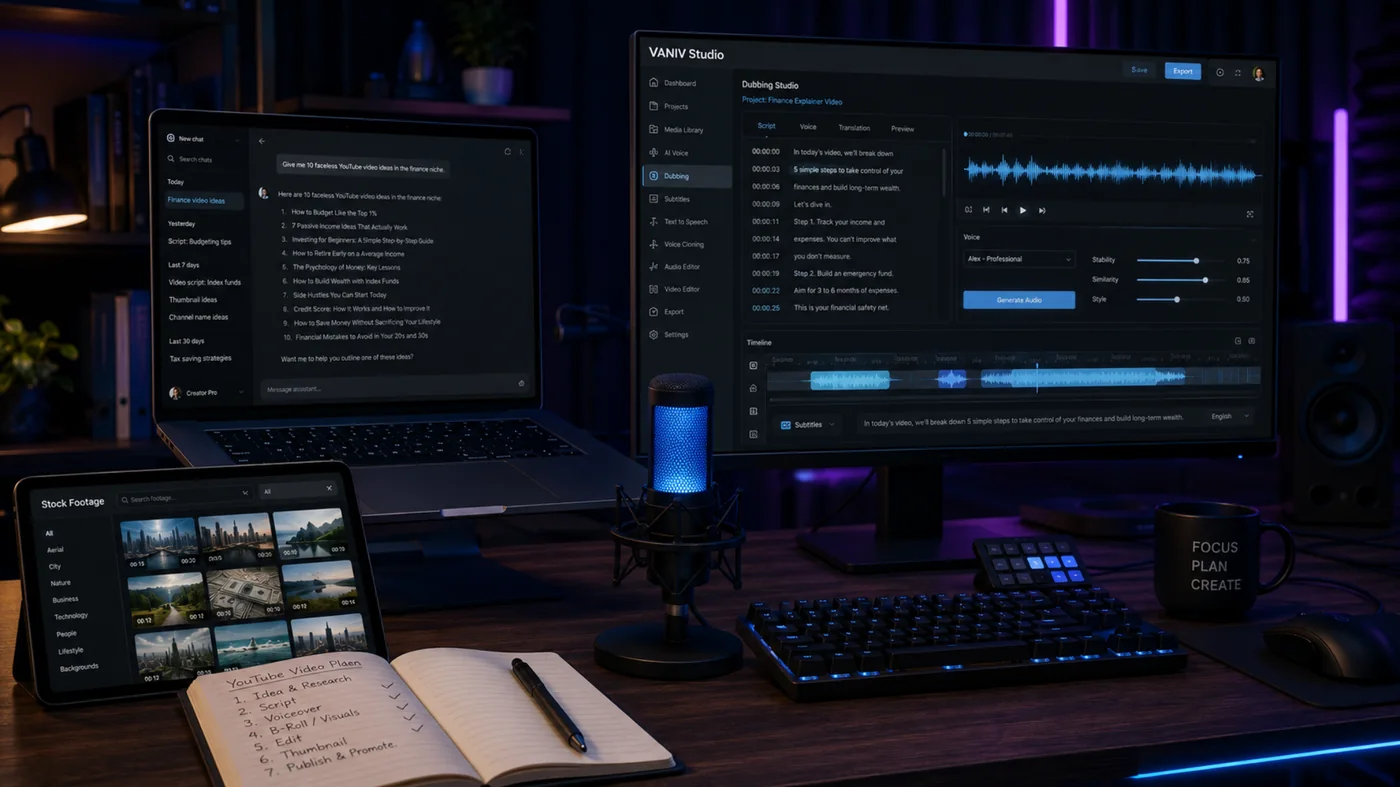
Faceless YouTube depends heavily on audio. If the voice sounds inconsistent, generic or disconnected from the video, the whole channel feels cheap. That is where VANIV Studio fits into the workflow.
VANIV is useful when you want a repeatable voice system
Instead of jumping between random cloud tools, you can build a more controlled local workflow for AI voice generation, voice cloning, subtitles and dubbing preparation.
Create AI voices
Turn scripts into voiceovers without recording every video manually.
Clone authorized voices
Use your own or properly authorized voice to create a recognizable channel sound.
Design voices
Plan voices for different formats, narrators or channel concepts.
Translate videos
If a video works, prepare versions for other languages and markets.
Prepare subtitles
Improve clarity, accessibility and multilingual workflows with subtitle-ready production.
Build a system
Reuse your workflow across videos instead of reinventing production every time.
For deeper related workflows, see the guides on voice cloning, video dubbing, video translation and GPUs for local AI.
Common mistakes that kill faceless channels
Most failed faceless channels do not fail because the creator lacked AI tools. They fail because the videos feel generic, the niche is too broad or the workflow produces volume without quality.
Generic AI voice
If the voice sounds like every other channel, you lose brand memory.
Random stock footage
Visuals must support the script. Random clips make the video feel cheap.
No clear niche
“Tech” is not enough. A focused viewer problem is much stronger.
Weak hook
If the first 10 seconds are vague, many viewers leave before the value starts.
No monetization path
Views alone are not a business model. Know how each topic can earn.
Publishing without learning
Uploading more is not enough. Study audience retention, click-through rate and comments.
Which faceless YouTube niches still work in 2026?
The niche matters more than the tool. A faceless channel can look polished and still fail if the topic has weak demand, low retention or no realistic monetization path. Strong faceless niches usually have three things in common: repeatable video ideas, clear search intent and a reason for viewers to trust the channel even when no host appears on camera.
This is where many “AI automation” guides become misleading. A faceless YouTube channel is not just stock footage plus a synthetic voice. The best channels feel structured, useful and recognizable. The voice, pacing, thumbnail style, topic selection and publishing rhythm need to work together.
For VANIV, this is the natural angle: faceless creators do not only need a voice file. They need a repeatable local workflow for scripts, AI voiceovers, subtitles, video dubbing, language versions and exports. That is a different mindset than jumping between random cloud tools for every upload.
| Niche | Why it can work | Monetization fit | VANIV fit |
|---|---|---|---|
| AI tools and software | High search intent, fast-moving market, endless comparison topics. | Affiliate, sponsorships, templates, consulting. | Very strong: tutorials, voiceovers and multilingual explainers. |
| Productivity and automation | Evergreen demand from creators, founders and solo businesses. | Tool affiliate, newsletters, courses, digital products. | Strong: calm narration, recurring formats and subtitles. |
| Tech explainers | Complex topics can be explained well without a presenter on camera. | Affiliate, hardware, sponsorships, education products. | Very strong: screen recordings, AI voices and local production. |
| Business and finance | High advertiser value, but trust is harder to earn. | Ads, leads, affiliate, courses. | Medium: the voice has to sound credible, not generic. |
| Storytelling and documentaries | High watch time potential when the story is strong. | Ads, sponsorships, serial formats. | Strong: voice design and consistent narration matter a lot. |
| Gaming lore and rankings | Strong communities and many repeatable topics. | Ads, sponsorships, community products. | Medium: copyright and source material need extra care. |
Reality check
Do not start with the niche that promises the highest revenue on paper. Start with the niche where you can create fifty useful video ideas without running out of energy. Faceless YouTube is not a one-video trick. It is a publishing system.
Three realistic faceless YouTube channel ideas for a VANIV workflow
The easiest way to make this practical is to look at concrete channel models. The goal is not to chase hype. The goal is to build repeatable formats with useful content, clear audience intent and monetization that makes sense.
1. AI tools explained
Short tutorials, comparisons and practical workflows for creators, freelancers and small businesses. Example videos: “7 AI tools that save creators time”, “ChatGPT vs local AI tools”, “How to build a simple content workflow with AI”.
2. Productivity without showing your face
Videos about better systems, software stacks and automation. This format works well when the voice is calm, clear and familiar across many uploads.
3. Software and hardware guides
Guides around local AI setups, creator PCs, GPUs and workflow tools. Example videos: “Which GPU do you need for local AI?”, “Local AI vs cloud subscriptions”, “Voice cloning on your own PC explained”.
The full faceless YouTube workflow: from idea to published video
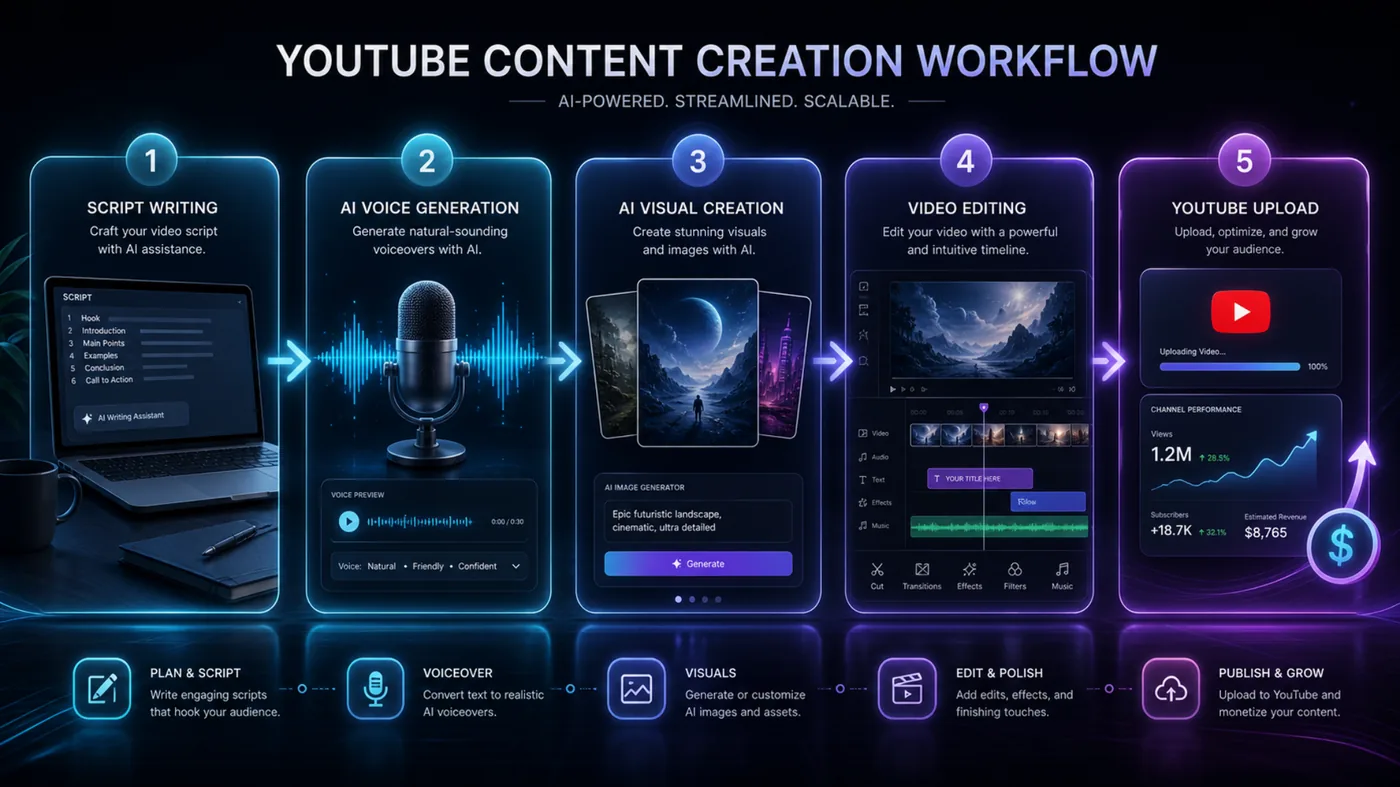
A faceless channel only becomes scalable when the process is repeatable. One good video is nice. A workflow that lets you produce, improve and republish consistently is much more valuable.
AI helps most when it removes friction from the production chain. It should not remove thinking. If the research is weak, the script is boring and the voice sounds generic, the video will still fail. The tool stack only matters after the concept is clear.
Validate the niche and search intent
Use YouTube search suggestions, competitor comments, Google Trends and real viewer questions. You are looking for problems people already care about, not random topics that only sound interesting to you.
Collect ten video ideas before the first upload
If you cannot find ten solid titles, the niche may be too narrow or you do not understand it deeply enough yet. Good faceless channels are built as series, not isolated experiments.
Write a script with a clear hook
The first line has to give viewers a reason to stay. A strong structure is simple: problem, promise, examples, mistakes, next step. In faceless content, structure replaces on-camera personality.
Create the AI voiceover
The voice decides whether the video feels professional or disposable. VANIV can support local AI voiceovers, voice design and authorized voice cloning as part of a repeatable creator workflow.
Add visuals, screen recordings or B-roll
Faceless does not mean visually empty. Use screen recordings, product demos, charts, text cards, stock clips or simple motion graphics. The visuals should support the narration, not distract from it.
Check subtitles, pacing and retention
Subtitles are also a quality-control layer. If a sentence looks too long as text, it often sounds too long as speech. Shorter and clearer usually beats faster and louder.
Optimize title, thumbnail and description
No click means no watch time. The title and thumbnail need a clear promise, but they should not lie. For AI and software topics, concrete outcomes usually work better than vague hype.
Review the early signals after 48 hours
Use click-through rate, audience retention and comments as early signals, then keep watching as more data arrives. If people click but leave quickly, the promise may be stronger than the video. If they do not click, the packaging may need work.
The VANIV advantage is repeatability
The more videos you produce, the more consistency matters. A local voice and dubbing workflow helps you keep the same sound, speaker profile and export process across many videos instead of starting from zero every time.
AI voiceovers, voice cloning and trust in faceless videos
For faceless YouTube, the voice is not decoration. It is the host. Viewers may never see a face, but they still react to confidence, pacing, pronunciation and emotional tone. A weak voice makes even useful content feel cheap.
Generic cloud voices can be useful for quick tests. But if you are building a long-term channel, you should think about voice identity. Do you want a neutral explainer voice? A warmer narrator? A more energetic tutorial voice? Or an authorized cloned voice that becomes part of the brand?
This is exactly where local-first production becomes interesting. With VANIV, the strategic goal is not just “generate a voice file”. The goal is to keep voice, subtitles, dubbing, SFX and export closer together inside one workflow.
Use a standard AI voice if…
You are testing a format, publishing simple explainers or do not need a strong personal voice identity yet.
Use voice cloning if…
You have clear rights, a recognizable voice and want consistency across many videos, languages or course modules.
Use voice design if…
You want a specific style without copying a real person. This can be useful for brands, fictional narrators or niche channels.
Use subtitles by default
Subtitles improve accessibility, help mobile viewers and reveal timing problems before the final export.
How faceless YouTube channels can actually make money
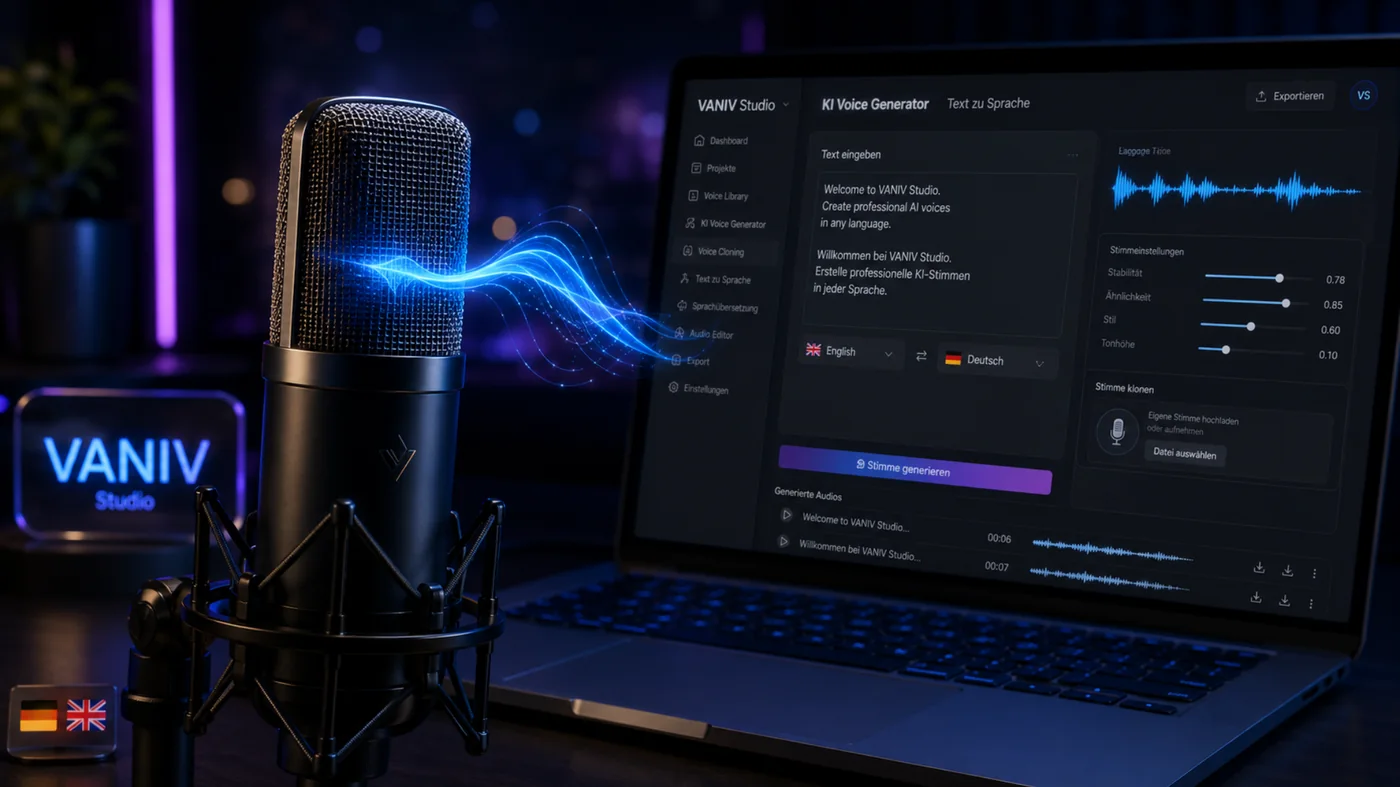
Many faceless YouTube articles over-focus on AdSense. Ad revenue can become useful, but it is rarely the only path. In many niches, affiliate marketing, software recommendations, hardware guides, sponsorships, newsletters or your own digital products can matter earlier.
A small tech channel with 30,000 monthly views will not automatically become a business from ads alone. But if the audience is specific and the videos solve purchase-related problems, a small number of viewers clicking relevant software or hardware recommendations can be more valuable than generic ad revenue.
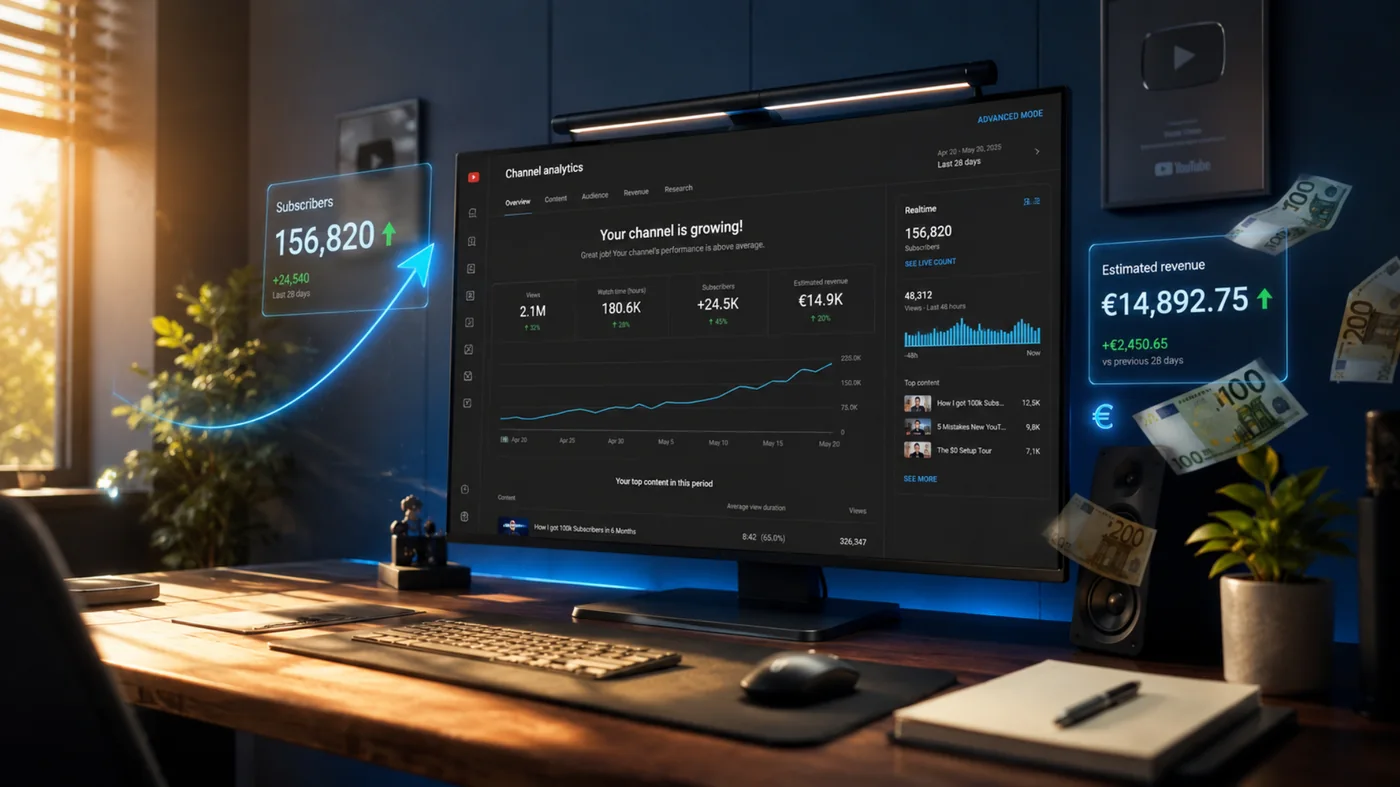
30-day starter plan for a faceless YouTube channel
You do not need a perfect brand to start. You need a workflow that produces feedback. The first month should be about learning what people click, where they drop off and which topics deserve more videos.
Week 1: Foundation
Choose one niche, collect thirty possible titles and study three competing channels. Look for repeated questions, not just popular videos.
Week 2: Production system
Create one short test video. Try your AI voice, subtitles, pacing, visuals and export settings before you commit to longer videos.
Week 3: First uploads
Publish three videos without waiting for perfection. Track click-through rate, retention and comments. Each upload should teach you one thing.
Week 4: Improve and repeat
Turn the best topic into a series, add relevant links only where they help and consider translation once one video proves demand.
The key is boring but powerful: repeat the process, improve the weak points and avoid turning every video into a new tool experiment. VANIV fits best when it becomes part of that repeatable production system.
Frequently asked questions about Faceless YouTube

Build your Faceless YouTube voice workflow with VANIV Studio.
Create voiceovers, test voice cloning, prepare subtitles and turn successful videos into multilingual versions with a more controlled local-first workflow.
Try VANIV Studio