
Scale your YouTube channel in 5 languages with local voice cloning
Use this as your multilingual YouTube workflow hub
This guide connects local voice cloning, dubbing, subtitles and language expansion into one repeatable workflow. Start with one proven video, create one controlled language version, then scale only when retention and search intent justify it.
Related VANIV resources: local video dubbing, voice cloning workflow and multi-voice dubbing for creator videos.
A strong YouTube video is too valuable to publish in only one language. Once research, script, recording, editing and thumbnail are already done, a second, third or fifth language version can become the smartest growth move.
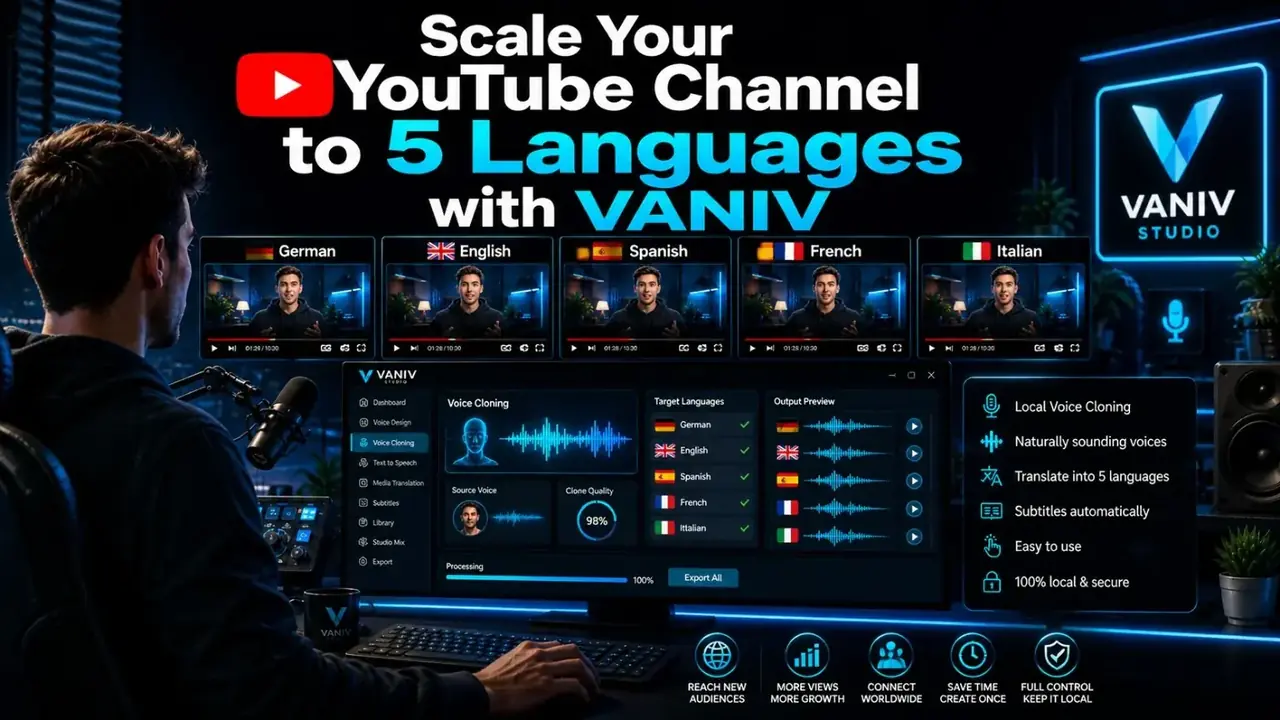
This guide shows how to turn one original video into localized versions for English, German, Spanish, French and Italian — using local voice cloning, AI dubbing, subtitles and a realistic VANIV Studio workflow.
Jump straight into the strategy
The real lever is not more production. It is controlled reuse.
Many creators try to grow by producing more: more scripts, more recordings, more edits, more uploads. That can work, but it also burns time fast. The smarter path often begins with using proven content better.
A video that already earns watch time, comments, clicks or sales in your main language has proven something important: the topic works. It is no longer just an idea. It is validated content. Those are exactly the videos that deserve a serious multilingual test.
The mistake is trying to automate everything immediately: five languages, hundreds of videos, several channels and no quality control. That sounds productive, but it usually creates generic content. A stronger workflow is controlled: choose a few winning videos, create clean language versions, review audio and timing, localize titles and thumbnails, then scale what the data supports.
The simple strategy
- Produce one strong original video.
- Use your own, saved or designed voice.
- Create localized versions for new markets.
- Adapt title, thumbnail, description and CTA per language.
- Scale only the videos and languages that show real signals.
This is where VANIV Studio fits into the workflow. Not as a magic button that runs YouTube for you, but as a local AI studio that helps you produce voice cloning, dubbing, subtitles and language versions with more control.
Why multilingual YouTube is worth testing
Multilingual audio, dubbing workflows and localized packaging give creators practical ways to reach viewers beyond their original language.
The opportunity is real, but easier production does not lower the quality bar. A second language is worth testing when a strong video addresses a problem that also exists in another market.
That does not mean every video needs five language versions. It means your best videos deserve a second look. If a video solves a clear problem, teaches a workflow, compares tools, explains software, sells a course or supports an affiliate offer, there may be demand in more than one market.
The advantage is simple: you are not producing five completely new videos. The most expensive work is already done: research, structure, script, recording, editing and the core visual concept. Multilingual scaling starts from that existing asset and turns it into a controlled content system.
Important: multilingual does not automatically mean better.
A weak video does not become strong just because it exists in five languages. Multilingual scaling is most useful when the original video already shows promising signals or solves a clear evergreen problem. Quality first, scaling second.
Not every YouTube video should be translated into five languages.
The most important decision happens before dubbing: choosing which videos actually deserve international versions.
Multilingual YouTube scaling works best when the original video solves a clear problem. A tutorial, software comparison or evergreen guide is much easier to internationalize than a local inside joke, a short-lived news reaction or a video that only works because of regional context.
Videos with lasting search intent
Tutorials, tool guides, software explainers, product comparisons, course lessons, hardware guides and faceless formats are strong candidates. People search for those problems in several languages. If your solution is clear, it can work in other markets too.
Videos with heavy local context
Local news, regional trends, dialect humor, personal stories and videos with many cultural references are harder. They can still work, but they need deeper adaptation than simple translation.
| Video type | Fit | Why | VANIV fit |
|---|---|---|---|
| Software tutorial | Very high | The problem and solution are easy to understand internationally. | Voiceover, subtitles, dubbing |
| AI tool comparison | Very high | Search intent, affiliate potential and global interest. | Voice cloning, localized versions |
| Hardware guide | High | Many viewers want recommendations in their own language. | Dubbing, subtitles, product explanations |
| Online course | High | Existing lessons can open new markets. | Saved voices, export, subtitles |
| Local news | Low to medium | The context is often regional and short-lived. | Only with strong adaptation |
If you do not have a clear winner yet, do not start with five language versions. Create better original videos first. Once a video shows signals, multilingual scaling becomes much more interesting. This also fits a faceless YouTube workflow, because strong scripts, voices and visuals can be reused.
Why English, German, Spanish, French and Italian?
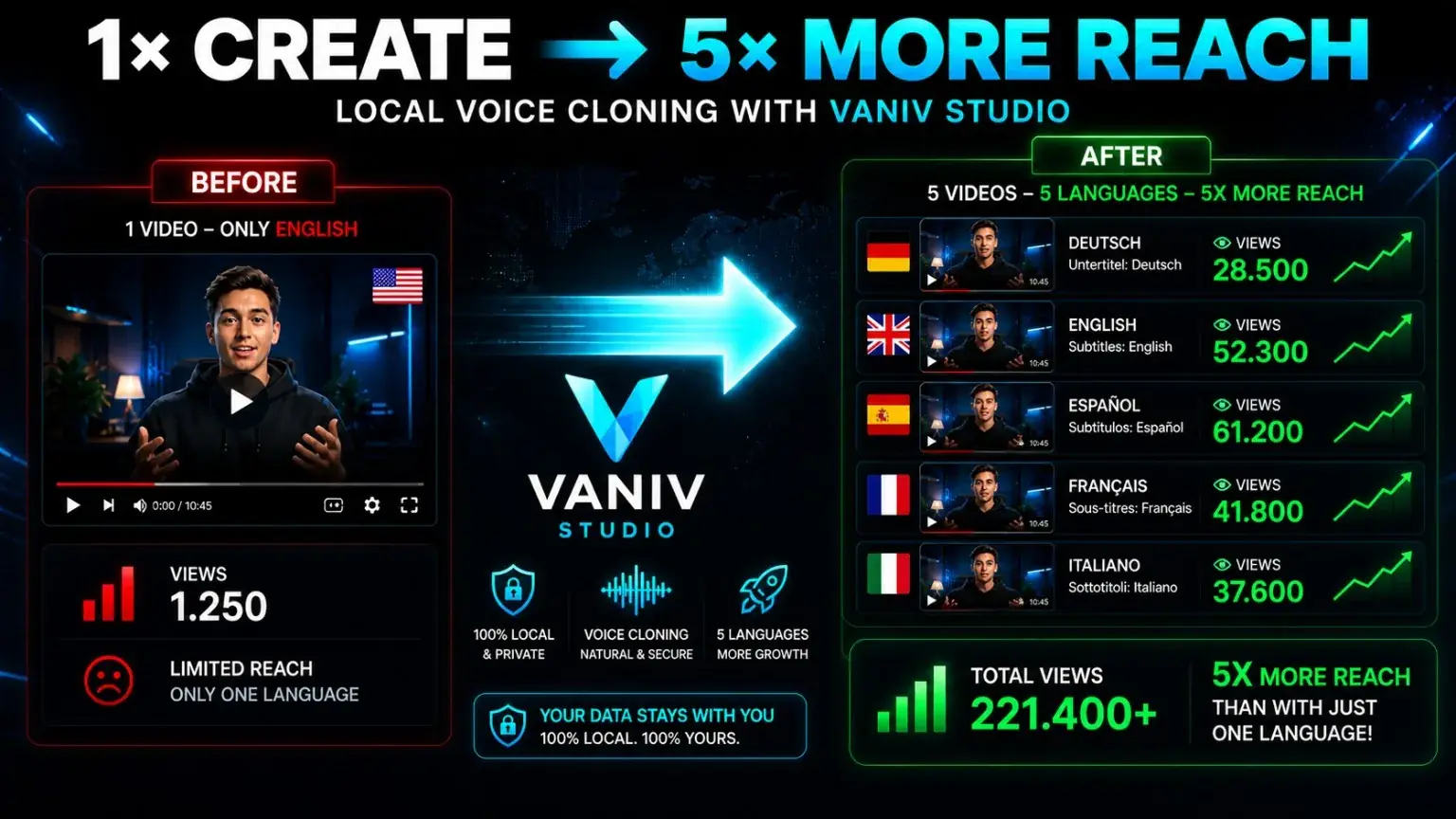
Five languages are not a rule. They are a practical starting point when you want to turn a European creator workflow into international reach.
English
English is often the biggest lever, but also the toughest market. It works best when your topic has global demand and your packaging is sharp.
German
German can be the original language for DACH creators. It builds trust, local relevance and a recognizable brand voice.
Spanish
Spanish is often underestimated. Tutorials, software, business and practical explainers can be especially interesting.
French
French can work well for education, business, software and quality-driven explainers. It may be less crowded than English.
Italian
Italian is smaller, but still useful for tech, lifestyle, creator workflows and practical tutorial content.
The order does not need to be the same for every creator. If your topic is highly international, English is usually the first test. If your content is practical and tutorial-based, Spanish can be a strong early second language. French and Italian are often useful once the workflow is stable and you are no longer rebuilding every video by hand.
English or Spanish first? How to decide.
Many creators want to do all five languages immediately. A better approach is to choose a sequence based on topic, audience and monetization.
When your topic is international and competitive
English is a strong first test when your video covers global topics: AI tools, software, creator workflows, business, hosting, productivity, hardware or tutorials. The market is large, but it is also highly competitive. Your English version needs a clear title, a strong thumbnail and a direct value promise.
For VANIV-related topics, English is often the logical first test because voice cloning, AI dubbing, video translation and faceless YouTube are searched internationally.
When your video is practical, educational or problem-focused
Spanish is interesting when your video solves a concrete problem. Tutorials, software demos, tool explanations, courses and step-by-step guides can work well here. The market is large, but depending on the niche it may be less saturated than English.
If your time is limited, a good sequence is often: your original language, then English as the international test, then Spanish as the second growth market. French and Italian come later once the workflow is stable.
| Situation | Best next language | Why |
|---|---|---|
| AI tool, SaaS, software, tech tutorial | English | High international demand and good monetization potential. |
| Simple how-to guide or practical problem | Spanish | Large market and strong demand for practical tutorials. |
| Course, education, business or premium offer | English or French | Depending on the audience, quality may matter more than volume. |
| Creative, lifestyle or niche video | Italian as a test | Smaller market, but engaged audiences in some topics. |
One channel or separate language channels?
This is one of the most important decisions. The wrong structure can dilute your data or confuse your audience.
Easier start, less management
One main channel is simpler to manage. You can test language versions, use playlists and see whether international viewers respond at all. For the beginning, this is often the most practical path.
The downside: your audiences may mix. A German viewer may not care about Spanish uploads. If too many languages appear without structure, the channel can feel messy.
Cleaner per market, but more work
Separate channels can be cleaner. Titles, thumbnails, community, descriptions and upload timing can be adapted for each market.
The downside: you are building several channels at once. That takes organization, planning and analysis. I would only consider separate channels once a language repeatedly shows strong signals.
Practical recommendation
Do not start with five new channels. Test a few winning videos in English and Spanish first. If one language repeatedly brings good watch time, clicks or revenue signals, then consider a dedicated language channel.
The complete 5-language workflow with VANIV Studio
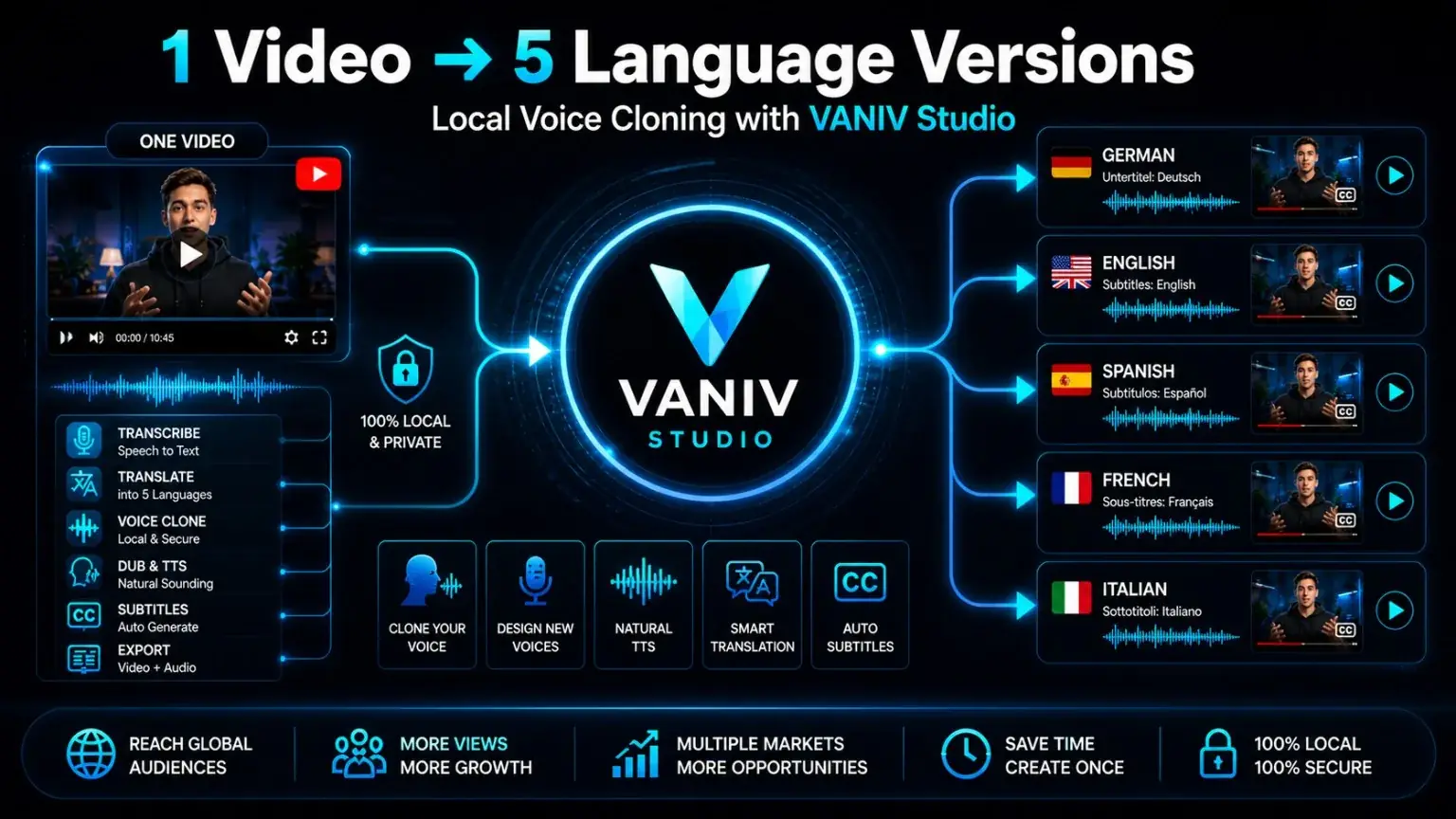
This is not about clicking once and getting rich. It is about a repeatable production process that combines quality and speed.
Choose the original video
Start with a video that already works or has strong evergreen potential. Tutorials, reviews, explainers, course lessons and product demos are ideal. The clearer the problem, the easier it is to localize.
Check audio and speaker structure
A video with clear speech, limited background noise and a clean structure is easier to translate. If there are multiple speakers, speaker structure matters. That is where multi-speaker dubbing becomes relevant.
Create or select the voice
Use your own voice if personal brand consistency matters. Or use voice design to create a fitting narrator voice. The key is consistency: a channel should not sound completely different in every video.
Review transcription and translation
Automatic translation is useful, but product names, brand names, technical terms and calls to action need review. In software and AI content, accuracy builds trust.
Create the dubbing
The goal is not to make every language mechanically identical. The goal is a natural version with clear meaning, believable rhythm and controlled timing.
Prepare subtitles and export
Subtitles are not only accessibility. They help comprehension, repurposing, shorts and international content workflows. Export clean files and name each language version clearly.
Quality-check each language
Listen to critical points: intro, product names, prices, calls to action, technical terms and transitions. Small mistakes can damage trust, especially in affiliate or course videos.
Upload and analyze
After export, YouTube work begins: title, thumbnail, description, chapters, links and end screens. Then measure CTR, watch time, comments, subscribers and conversion by language.
Why local instead of only cloud?
When you create recurring language versions, control becomes important. Local workflows reduce credit pressure, make saved voices reusable and fit creator processes where you test several versions. For the bigger cost perspective, read the cloud vs local AI cost comparison.
Test VANIV StudioTranslation is not enough: every language needs local packaging.
If you translate only the audio but ignore title, thumbnail and description, you waste a large part of the opportunity.
A German title rarely becomes a great English, Spanish or French title through literal translation. People search differently. They click differently. Some markets respond to direct promises, others prefer clear explanation. Localization is not decoration. It is part of the content strategy.
Search intent over literal wording
The title must match the problem in the target language. Clear and clickable beats perfectly literal.
Text, emotion and clarity
Thumbnail text should be short. Check whether visual style, colors and message make sense for that audience.
Adapt links and CTA
Affiliate links, product pages, trial links, chapters and disclaimers should make sense in the target language.
Make the promise clear
The first seconds matter. A strong German intro may feel too slow or indirect in English.
Check technical wording
Product names, tool names and technical terms should not be translated awkwardly. This is where manual review matters.
Guide the market properly
A CTA for a trial, newsletter, affiliate link or course should fit the language and offer.
The checklist before every multilingual upload
Dubbing is only half the work. The other half decides whether the new language version gets clicked, understood and monetized.
Check voice and pronunciation
Listen to the intro, technical terms, product names, prices and calls to action. These points build or break trust.
Localize search intent
Do not use a word-for-word title. Write the way people in that language actually search and click.
Keep text short and readable
Thumbnail text must fit the language. English, Spanish and French often need different text lengths.
Separate links and CTAs
If you use affiliate links or trial links, separate them by language. Otherwise you will not know which market works.
Check readability
Subtitles help understanding, repurposing and shorts. Review timing, line length and important terms.
Measure by language
Track CTR, watch time, comments, subscribers, link clicks and revenue. Without measurement, scaling is just guessing.
Practical mini-test
Do not start with your entire channel. Choose one strong video, create English and Spanish versions, localize the upload assets properly and check the first signals after 7 to 14 days.
Test VANIV with your own videoHow multilingual YouTube videos can make money
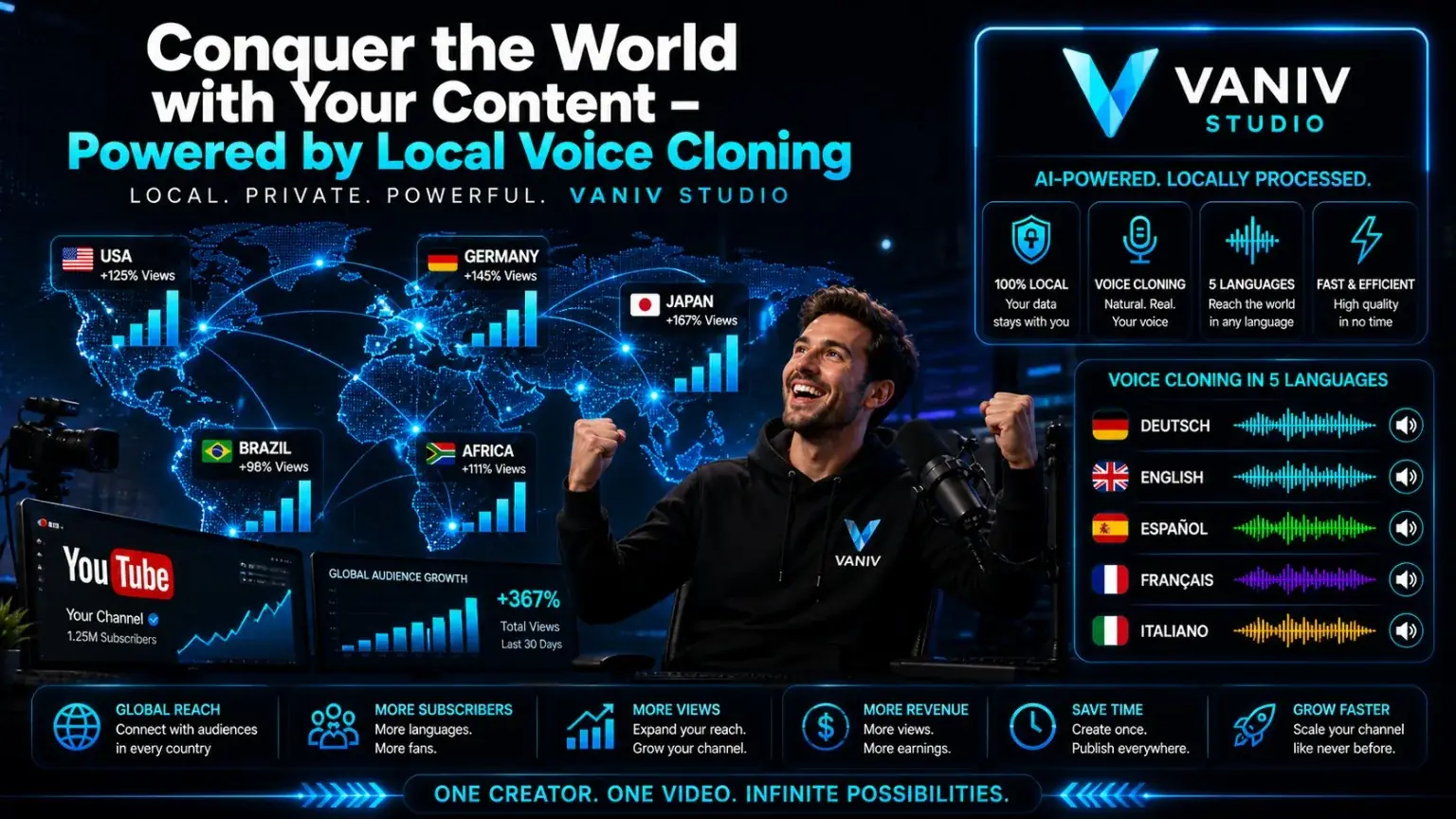
More languages are only useful when there is a clear goal: reach, leads, affiliate revenue, course sales or product demos.
Software, hosting and hardware
If your video explains or compares a tool, an English or Spanish version can reach additional buyers. This is especially interesting for software, hosting, AI tools and creator hardware. For hardware topics, link naturally to your GPU guide.
Courses, templates and digital offers
A course or template does not need to sell in only one language. If the content is internationally understandable, multilingual dubbing can open new audiences.
Video translation as a service
If you use VANIV for your own videos, you can also test the workflow as a service: short demo scenes, voiceover, dubbing or translation for other creators.
International visibility
Multilingual videos can build trust in markets that would never find you otherwise. This is especially relevant for tools, SaaS, agencies and B2B offers.
Mistakes multilingual creators should avoid
- Translating everything blindly: Not every video deserves five versions. Start with proven winners.
- No quality control: Dubbing without review can break technical terms, pacing or calls to action.
- Same thumbnails everywhere: Competing results and viewer expectations vary by market. Test localized versions.
- Too many channels too early: Five empty channels are not a business. Get signals first, then scale.
- Using voices without permission: Use your own or clearly authorized voices. Anything else is not a clean strategy.
- Only watching views: Watch CTR, watch time, comments, subscribers and revenue signals.
- No useful next step: Link to relevant guides, product pages and offers so interested viewers know where to continue.
30-day plan: test five-language scaling without chaos
The best start is not mass uploading. The best start is a controlled test with a few videos and clear metrics.
Week 1: choose winners
Pick three videos with good watch time, clear search intent or revenue potential. Check whether the topic is internationally understandable. Collect English and Spanish title ideas.
Week 2: test English
Create English versions of your strongest videos. Review voice, timing, subtitles and description. Do not simply upload — optimize title and thumbnail for the English market.
Week 3: add Spanish
Once the workflow feels stable, create Spanish versions. Pay attention to natural language and clear thumbnails. Compare the first signals with your original and English versions.
Week 4: test French and Italian
Add more languages only for your strongest videos. Track which topics work in which language. This becomes your real scaling plan.
What to measure
Track click-through rate, average view duration, comments, subscribers, link clicks and revenue by language. If you use affiliate or trial links, separate them by language. Otherwise you will not know which market actually works.
Common questions about scaling YouTube with local AI voices

Test VANIV Studio with your own YouTube video.
Check whether your content is suitable for multilingual versions. Import a video, test voice, dubbing, subtitles and export — locally on your Windows PC.
- test your own or saved voices
- design new voices from descriptions
- try video dubbing and TTS
- evaluate language versions for your content